
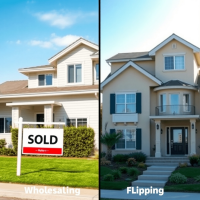
If you hang around real estate long enough, you’ll hear the same two words over and over. Wholesaling. Flipping.
And they get treated like rival sports teams. Like you have to pick one and swear loyalty forever. But most people are not really choosing a “team”. They’re trying to choose a path that fits their money situation, their time, their stress tolerance, and honestly their personality.
Because these two strategies feel totally different in real life.
One is basically a sales and marketing game. The other is a project management and construction game. One can get you paid faster but usually in smaller chunks. The other can pay bigger, but the timeline can stretch and the risks multiply.
So let’s make it simple and real. No hype. No guru vibes.
First, what wholesaling actually is (without the fluff)
Wholesaling is when you find a discounted property, get it under contract, and then assign that contract to a buyer (usually a cash buyer or investor) for a fee.
You are not buying the house. You’re selling the deal.
Typical flow looks like this:
1. You find a motivated seller (or a property listed cheap enough that it still works). 2. You get the property under contract at a price that leaves room for an investor to profit. 3. You find an end buyer.
4. You assign the contract and collect an assignment fee at closing.
That fee might be $5,000. Or $15,000. Or $30,000. Depends on the market, the deal, how good you are, and how much demand there is from buyers.
The core skill in wholesaling is not construction knowledge.
It’s lead generation, negotiation, and building a buyers list. It’s being able to say, “I can bring you deals,” and then actually do it consistently.
Because it’s the lowest capital entry point.
You’ll still spend money, usually on marketing, skip tracing, a CRM, maybe earnest money, maybe transaction coordination. But you don’t need a down payment, you don’t need a renovation budget, you don’t need to qualify for a loan.
If you’re short on cash but willing to hustle, wholesaling is often the first door people can actually open.
Now flipping, in plain terms
Flipping is when you buy a property, renovate it (or improve it), and resell it for a profit.
You own the house. You’re taking on the risk, the holding costs, the renovation decisions, the timeline, the resale, the market fluctuations. The whole thing.
Typical flip flow:
1. Find a property priced low enough to buy, renovate, and still profit.
2. Buy it using cash, hard money, private money, or conventional financing (depends on your plan).
3. Renovate.
4. List it or sell off market.
5. Pay off lenders, contractors, holding costs, closing costs.
6. What’s left is your profit.
Flipping looks sexy on Instagram. In real life it’s a bunch of receipts, change orders, surprise leaks, scheduling problems, and you learning what a soffit is at 9 pm on a Tuesday.
But it can be worth it. Flips can produce larger single paydays than wholesaling.
Also, flipping builds a different kind of credibility. People take you more seriously when you can say, “I bought this, renovated it, and sold it.” Even if that’s not fair, it’s just how it goes.
Wholesaling vs. flipping: the real differences that matter Let’s compare them the way you’ll actually feel them.
Wholesaling: lower cash requirement.
You can start with a phone, a laptop, and a marketing plan. But you’ll still need some money if you want consistency. Marketing costs are real. Pulling lists, skip tracing, direct mail, PPC, cold calling. It adds up.
Flipping: higher cash requirement.
Even if you use hard money, you need reserves. You need cash for closing gaps, overruns, utilities, insurance, dumpsters, permits, random stuff that appears. Plus lender requirements. Some lenders want experience or a larger down payment if you’re new.
If you’re basically broke, flipping is hard to start safely. And “safely” matters here.
Wholesaling risk is mostly operational.
Meaning you risk spending money on marketing and not getting deals. Or putting a deal under contract and not finding a buyer fast enough. Or messing up paperwork. Or getting a reputation hit with buyers if you’re sloppy.
But you’re usually not risking tens of thousands on a rehab.
Flipping risk is financial and market based.
You can lose money on a flip. Not just “make less than you expected”. I mean actually lose money. Market shifts. Interest rates. Appraisals. Contractor problems. Permits. Theft. Vandalism. A roof that turns into a full structural mess.
You’re taking on more variables and more liability.
Wholesaling can pay faster.
A wholesale deal might close in 7 to 30 days, depending on the situation. Sometimes longer, but generally it’s a faster cycle.
Flipping takes longer.
A flip can easily be 4 to 9 months, and that’s not even a horror story, that’s normal. If you hit serious delays, a “quick flip” becomes a year.
And every month you hold a flip, the property costs you money. Interest. taxes. insurance. utilities. lawn care. snow removal. all of it.
Wholesaling is sales.
Lead gen, rapport, negotiation, follow up, and speed. You have to be comfortable hearing “no” all day.
If you’ve ever done any sales job, wholesaling will feel familiar. The top wholesalers are not “real estate geniuses”. They are consistent marketers and relentless follow up machines.
Flipping is operations and people management.
You’re managing contractors, materials, timelines, inspections, budgets, scopes. You need to understand enough to not get wrecked, even if you’re not swinging a hammer yourself.
Flipping is less about “can you do construction”. It’s more like, can you run a mini business project under pressure.
This is where people get emotional.
Flips can pay more per deal.
A solid flip might net $30,000, $60,000, $100,000+. In some markets, even more. But that’s not every flip, and it’s never guaranteed until it sells and the final numbers settle.
Wholesale fees are usually smaller, but faster.
A common wholesale fee might be $10,000 to $25,000. Some wholesalers do big fees, sure. But the strategy is often volume and consistency.
Also, wholesaling profit is clearer earlier. You usually know your assignment fee before closing. With flipping, surprise costs can chew your profit slowly until you’re looking at your spreadsheet like… wait. where did it go.
This is underrated.
Wholesaling stress is repetitive.
It’s the grind. The constant outreach. The follow up. The rejection. The deals that fall apart because a seller changes their mind. It can feel like dating. A lot of talking. A lot of maybe. Some ghosting.
Flipping stress is heavy.
Because you own the problem. If your contractor disappears, you still have a half demolished kitchen. If the city fails your inspection, you still have carrying costs. If the market softens, you
still have a loan payment.
Some people thrive on that control. Some people hate it.
Quick scenario examples (to make this feel real)
You work a job, you can put in evenings and weekends, you have maybe $1,000 to $3,000 you can risk learning.
Wholesaling is probably the better fit. Not because it’s “easy”. But because it’s less likely to financially destroy you while you’re learning.
You’ve got savings, maybe access to credit, maybe a partner, but you’re busy. You want bigger wins and you’re okay hiring help.
Flipping might fit better, especially if you can build a team. If you can’t manage the project though, you can burn money fast. So this is not a free pass.
If you hate cold calling, hate negotiating, hate talking to strangers, wholesaling will feel like torture.
Flipping might be better because it’s more about execution. You still negotiate when you buy, sure. But it’s not lead gen every day.
Then don’t flip. Seriously. Flipping is basically “working with contractors” as a lifestyle. Even with great contractors, things happen.
Wholesaling will feel cleaner. Not always, but cleaner.
The legal and ethical side (yes, it matters)
Wholesaling is legal in many places, but it’s getting more regulated and more watched. Some states require a license for certain wholesaling activity. Some require specific disclosures. Some are cracking down on marketing practices.
Also, wholesalers can get into ethical trouble fast if they overpromise, mislead sellers, or market properties they don’t control properly.
Flipping has its own issues. Permits, disclosures, unpermitted work, and the temptation to do cheap cosmetic fixes that hide problems. That stuff can come back around, legally and reputationally.
So whichever route you choose, don’t do the shady version. It’s not worth it. And it’s not even
necessary. You can do this clean and still make money.
Which strategy is “better” long term?
This part is interesting because the truth is… a lot of investors do both. Wholesaling can be a great way to:
• learn how to find deals
• learn your market fast
• build relationships with cash buyers
• create cash flow to fund flips or rentals
Flipping can be a great way to:
• build larger chunks of capital
• build credibility with lenders and private money
• expand into buying rentals (BRRRR, etc) later
• create a real brand locally
A common path is: wholesale first, then flip.
Not because wholesaling is a “beginner” strategy and flipping is “advanced”. But because wholesaling can finance your education. You make money while you learn. And you see hundreds of deals before you risk owning one.
But you can also start flipping first if you have the resources and you’re careful. A practical decision framework (pick based on you, not YouTube) Here’s a simple way to choose.
• You have limited capital to risk.
• You can commit consistent weekly time to marketing and follow up. • You’re comfortable with sales, rejection, and negotiation.
• You want to get paid faster, even if it’s smaller per deal.
• You want to learn your market by doing a lot of reps.
• You have capital or strong financing access plus reserves.
• You can manage projects or you’re willing to learn fast.
• You’re okay with longer timelines and bigger uncertainty.
• You have some contractor relationships or can build them.
• You want bigger profit potential per deal and you can handle risk.
And one more that people don’t say enough:
If your personal life is already chaotic, flipping might be a bad idea right now. Because flipping adds chaos on purpose. Wholesaling can too, but it’s a different kind.
The numbers people forget to calculate
Whether you wholesale or flip, the deal is made in the math. Not in the motivation.
• assuming every buyer will pay your fee
• not accounting for title issues and delays
• putting properties under contract with unrealistic numbers
• burning cash on marketing without tracking acquisition cost per deal
A wholesaling business is basically a marketing business with real estate paperwork attached. Track your metrics or you’ll feel busy and stay broke.
• underestimating rehab costs (this is the big one)
• underestimating timeline (second big one)
• ignoring holding costs (they quietly kill profit)
• over improving for the neighborhood
• relying on a hot market to bail out thin margins
If you flip, you need cushions. Contingency budget. Time buffer. Exit strategy.
Exit strategies, because stuff goes wrong
A good investor has multiple exits.
• assign the contract
• double close (depending on your market and funding)
• wholetail (light clean up and list it, in some cases)
• cancel if you can’t perform and your contract allows it (careful with this, do it professionally)
• retail sale (traditional flip)
• sell to an investor (if the rehab goes sideways)
• rent it out (if the market shifts)
• refinance or pivot into BRRRR (in some situations)
• novation agreement in some markets (more advanced, talk to an attorney)
This is why buying right matters. If you buy right, you have options. If you buy tight, you have one option and you pray it works.
So… which one should you choose?
If you want the cleanest answer:
• If you need cash flow and you’re willing to do lead gen, start with wholesaling.
• If you have reserves and can handle project risk, and you want bigger paydays, consider flipping.
And if you’re still stuck, pick the one you can commit to for 90 days without switching.
That matters more than people think. Because both strategies work. What doesn’t work is bouncing every two weeks between wholesaling, flipping, Airbnb, land, self storage, and whatever trend is hot.
Do one thing. Learn it. Track it. Get your first win. Then expand.
A simple starter plan (not perfect, just useful)
• Pick one lead channel (cold calling or SMS or direct mail, not all three).
• Build a basic buyers list (local Facebook groups, meetups, calling landlords, investor associations).
• Learn your contracts and disclosures for your state. Talk to a local attorney if you can. • Underwrite deals conservatively. If the deal barely works on paper, it doesn’t work.
• Get preapproved or talk to hard money lenders and understand terms. • Build a rehab estimating template. Keep it simple.
• Walk properties with a contractor if possible. Pay them for their time if you have to. • Focus on boring bread and butter flips before you chase “big upside” disasters. Wrap up
Wholesaling is a fast, sales driven business that can build cash flow and deal finding skills quickly, with lower financial risk but a lot of hustle.
Flipping is slower and heavier, but can produce bigger profits per deal if you manage the numbers, the rehab, and the timeline without getting cute.
Neither is “better”. The right one is the one that fits your current resources and the kind of work you’ll actually do when it’s not exciting anymore.
Because that’s the whole game, really. Not the first week. The boring weeks. The follow up. The unexpected repairs. The days you don’t feel like it.
Pick the strategy you can stick with. Then do it long enough to get good.
FAQs (Frequently Asked Questions)
Wholesaling in real estate involves finding a discounted property, getting it under contract, and then assigning that contract to a buyer—usually a cash buyer or investor—for a fee. You don’t actually buy the house; instead, you sell the deal. The process typically includes finding a motivated seller, securing the property at a price that allows profit for an investor, finding an end buyer, and then collecting an assignment fee at closing.
Many people start with wholesaling because it requires the lowest capital entry point. While you will spend money on marketing, skip tracing, CRM systems, and possibly earnest money or transaction coordination, you don’t need a down payment or renovation budget. If you’re short
on cash but willing to hustle and learn sales skills like lead generation and negotiation, wholesaling is often the most accessible way to enter real estate investing.
Flipping is when you buy a property, renovate or improve it, and then resell it for a profit. Unlike wholesaling, you own the house during this process and take on risks such as holding costs, renovation decisions, timelines, market fluctuations, and resale logistics. The typical flip flow includes purchasing the property (using cash or financing), renovating it, listing or selling off market, paying off all associated costs like lenders and contractors, with any remaining amount being your profit.
Wholesaling requires lower upfront cash since you mainly invest in marketing efforts like direct mail or online ads to find deals and buyers. In contrast, flipping demands higher capital because you need funds for purchasing the property (cash or loans), renovation expenses, holding costs like utilities and insurance, permits, and unexpected overruns. New flippers also may face lender requirements such as experience or larger down payments.
The risks in wholesaling are mostly operational—spending money on marketing without closing deals, failing to find buyers quickly after contract assignment, paperwork errors, or damaging your reputation if sloppy. Financially you’re not exposed to large rehab costs. Flipping carries higher financial and market risks including losing money due to market shifts, contractor issues, permit delays, unexpected repairs (like structural problems), theft or vandalism—all adding complexity and liability.
Wholesaling generally pays faster because deals can close within 7 to 30 days depending on circumstances. Flipping takes longer—typically 4 to 9 months under normal conditions—and can extend up to a year if delays occur. Additionally, holding a flip incurs ongoing expenses such as interest payments on loans, taxes, insurance premiums, utilities, lawn care etc., which impact overall profitability over time.